
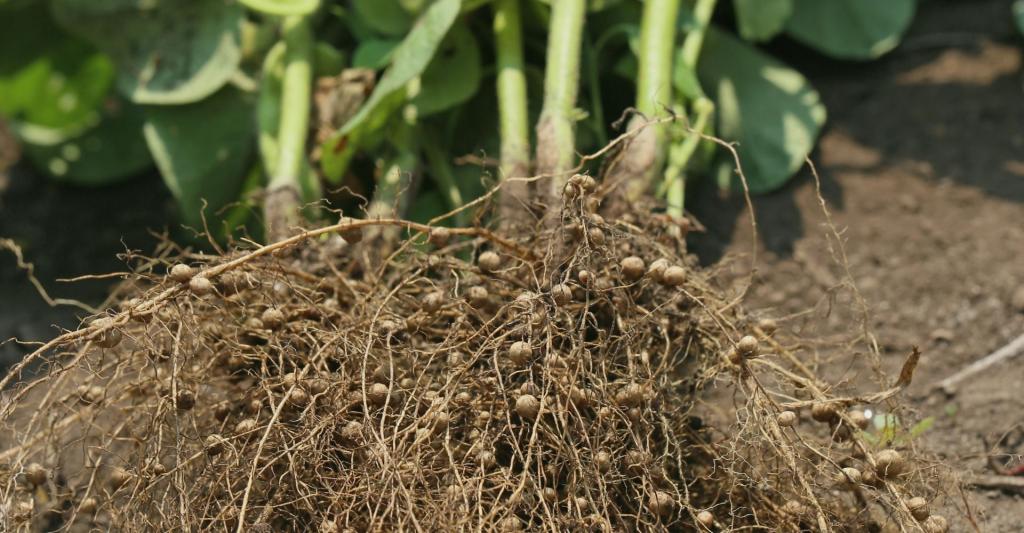
ENSA researchers in the group of Megan Leigh Matthews at the University of Illinois Urbana-Champaign have developed a computational model that identifies how nitrogen fixation could be improved in soybean and other legumes. The model highlights three enzymes, ZWF, PEPC and PYK, as potential engineering targets, predicting that coordinated changes in their activity could increase nitrogen fixation efficiency by 11% and fixation rate by almost 9%. The findings give researchers clear targets to test and help develop soybean varieties that have the potential to fix nitrogen more efficiently. In the long term, these advances could contribute to the development of higher-performing crops that require fewer fertilizer inputs. The research was published on 22 September in Metabolic Engineering.
A closer look inside the root nodule
Legumes such as soybean depend on a partnership with soil bacteria to fix nitrogen – a key nutrient for plants. These bacteria live within specialized root structures called nodules where they convert atmospheric nitrogen into forms the plant can use. In doing so, they reduce dependence on synthetic nitrogen fertilizers.
The partnership is beneficial, but also energetically expensive because of the ‘carbon cost’ to the plant. Previous studies have estimated that nitrogen fixation can significantly reduce yield because plant cells must continuously supply the bacteria with carbon in the form of sugars.
To better understand how these resources are allocated, the research team built a detailed computational model of nodule metabolism. The model captures dozens of interconnected biochemical reactions taking place inside nodules, making it possible to explore how small changes could affect the entire system.
“The model provides a way to investigate questions that are difficult to answer experimentally,” explains Matthews. “It allows us to see how the system works as a whole rather than focusing on one reaction at a time.”
Not all nodules use carbon in the same way
The simulations revealed clear differences between efficient and inefficient nodules. In highly efficient nodules, carbon is directed through metabolic pathways that more effectively support nitrogen fixation, while less efficient nodules divert more resources into competing processes.
These findings suggest that improving nitrogen fixation is not simply a matter of providing plants with more energy. Instead, efficiency depends on how carbon flows through the metabolic network and which biochemical pathways are prioritized.
“By simulating hundreds of possible metabolic states, we could identify a small number of enzymes that have a surprisingly large influence,” reflects Rourou Ji, ENSA PhD Fellow and first author of the study.
Three promising targets emerge
The model highlighted three enzymes that play particularly important roles in controlling carbon flow: ZWF (glucose-6-phosphate dehydrogenase), PEPC (phosphoenolpyruvate carboxylase) and PYK (pyruvate kinase). Together, these enzymes sit at key branch points in central carbon metabolism, helping determine how carbon is distributed between competing cellular processes.
The model predicted that the strongest improvements to nitrogen fixation could occur when ZWF and PYK activity were both reduced, or when ZWF activity was reduced while PEPC activity was increased.
Such changes to enzyme activity could increase nitrogen fixation efficiency by 11% and rate by almost 9%, highlighting these three enzymes as promising targets for future experimental studies.
Building a foundation for future research
While the current modeling work focuses on the nodule metabolism, the researchers see it as a foundation that can be expanded and integrated with other models to explore the larger scale impacts of improving nitrogen fixation efficiency on crop productivity.
The work also highlights the collaborative potential within ENSA, where computational modelling, plant biology, and engineering approaches come together to address one of agriculture’s biggest challenges: enabling crops to use nitrogen more efficiently.
By revealing how these enzymes influence the flow of carbon through nitrogen-fixing nodules, the study provides researchers with new targets. “It’s just the beginning,” reflects Ji. “When I think about how the model could combine with other projects in ENSA, it feels very meaningful and ambitious.”
In the long term, such insights could help researchers develop crops that use nutrients more efficiently and require fewer agricultural inputs, supporting more sustainable food production for global farmers.
Link to the full paper.
Image: Nodules on the roots of soybean plants (stock image).
Text: Emma Steer.
The Matthews Research Group is a highly collaborative and interdisciplinary group based in the Department of Civil and Environmental Engineering at The Grainger College of Engineering, University of Illinois Urbana-Champaign. They develop and use computational methods and models that incorporate and span across levels of biological information to identify strategies for engineering crops for the future.