
New ENSA (Enabling Nutrient Symbioses in Agriculture) research reveals that maize could experience dramatic growth improvements when supported by two microbial partners at once: nitrogen‑fixing bacteria and naturally occurring fungi (arbuscular mycorrhiza, AM). Using the first metabolic model of maize that integrates both partnerships, researchers found that under nutrient‑poor soil conditions, the combined symbioses have the potential to more than double maize’s predicted relative growth rate – surpassing what either partner could provide alone. The findings provide quantitative reassurance that developing nitrogen‑fixing maize – a major goal of ENSA – has the potential to work with, rather than against, a crop’s existing fungal allies. The paper, published in Plant Physiology in July 2026, supports ENSA’s vision to develop sustainable and equitable farming choices for global farmers.
Modeling reveals powerful microbe‑microbe synergy
Most plants, including the globally important crop maize, naturally partner with arbuscular mycorrhizal (AM) fungi, which help plants take up the major plant nutrient phosphorus. ENSA scientists are working to add a second partner: nitrogen‑fixing bacteria. Currently these bacteria can only form nitrogen‑fixing nodules in legumes like peas and beans. Until now, no studies had explored how these two nutrient‑acquiring systems might interact inside a cereal crop.
That’s why researchers in Megan Leigh Matthews’ group at the University of Illinois Urbana-Champaign constructed three metabolic models of maize and its partners: maize and AM fungi; maize and nitrogen-fixing bacteria; and maize partnering with both AM fungi and nitrogen-fixing bacteria.
In collaboration with ENSA group leader Ruairidh Sawers at Penn State University, the researchers experimentally validated their model of maize and AM fungi using field trial data. They found that the model performed well in comparison to real world data.
In the hypothetical model of maize associated with AM fungi and nitrogen-fixing bacteria, researchers predicted that maize’s growth rate could double, compared to maize growing in isolation. “This was a striking result,” commented first author of the study Joshua Kaste. “I was surprised at how much of an impact the AM fungi and nitrogen-fixing bacteria could potentially have on plant growth.”
The model predicted that this additive effect would be particularly sensitive to soil nutrient levels. In nutrient depleted conditions, the combined symbioses had a pronounced positive effect. However, the opposite would be true in high phosphorous soil, indicating that soil nutrient levels should be carefully considered in future real-world applications.
A major confidence boost for sustainable crop engineering
The authors emphasize that these predictions require further experimental validation, especially for the yet‑to‑be‑developed nitrogen‑fixing maize. But the modeling offers encouraging reinforcement for ENSA’s long‑term vision. Research to develop nitrogen‑fixing maize is a huge undertaking that will take time, and there are few projects in plant biotechnology that are as challenging. Yet the potential for crops to make their own fertilizer would be a huge impact for people and planet alike.
“To the best of our knowledge, this model strongly supports ENSA’s research into the molecular mechanisms behind nitrogen-fixing and AM fungi symbioses in plants,” says Matthews. “Our results suggest that these systems have the potential to work extremely well together.”
Read the full paper.
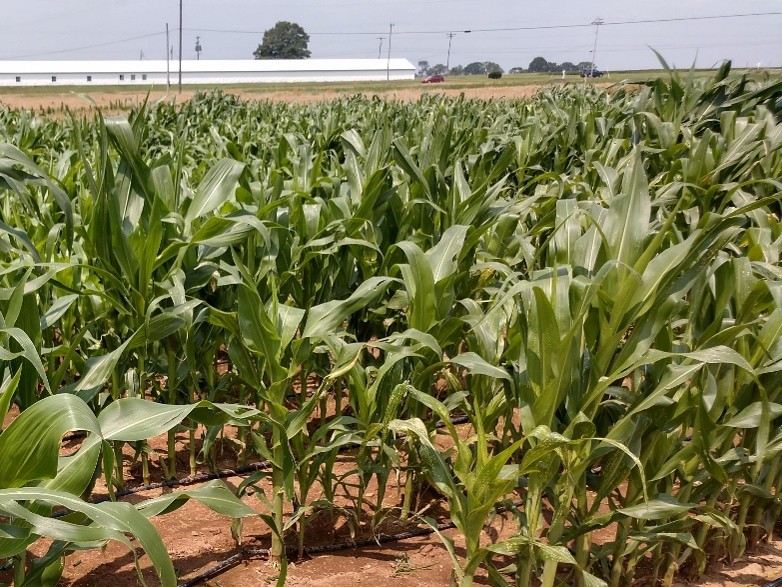
Image: Maize grown by ENSA group leader Ruaridh Sawers at Penn State University helped to experimentally validate the model of maize and AM fungi.
Text: Emma Steer.
The Matthews Research Group is a highly collaborative and interdisciplinary group based in the Department of Civil and Environmental Engineering at The Grainger College of Engineering, University of Illinois Urbana-Champaign. They develop and use computational methods and models that incorporate and span across levels of biological information to identify strategies for engineering crops for the future.