
A new publication from ENSA researchers and international collaborators has uncovered a crucial protein that helps plants initiate partnerships with beneficial soil microbes. The study, led by Thomas Ott (University of Freiburg, CIBSS), sheds light on the molecular basis of how legumes begin forming nitrogen‑fixing symbioses – and shows that similar processes can be activated in non‑legume tomato plants. ENSA Group Leader Pierre‑Marc Delaux (University of Toulouse) also contributed key evolutionary insights to the research. The research was published in Science on 5 March 2026.
Identifying a key protein in early symbiosis
Legume plants such as peas and beans host nitrogen-fixing bacteria called rhizobia in specialised root nodules. These bacteria provide the plant with nitrogen from the air, in exchange for carbohydrates. To initiate this symbiosis, root hairs must capture a bacterium and remodel their internal structure to allow it to enter the root.
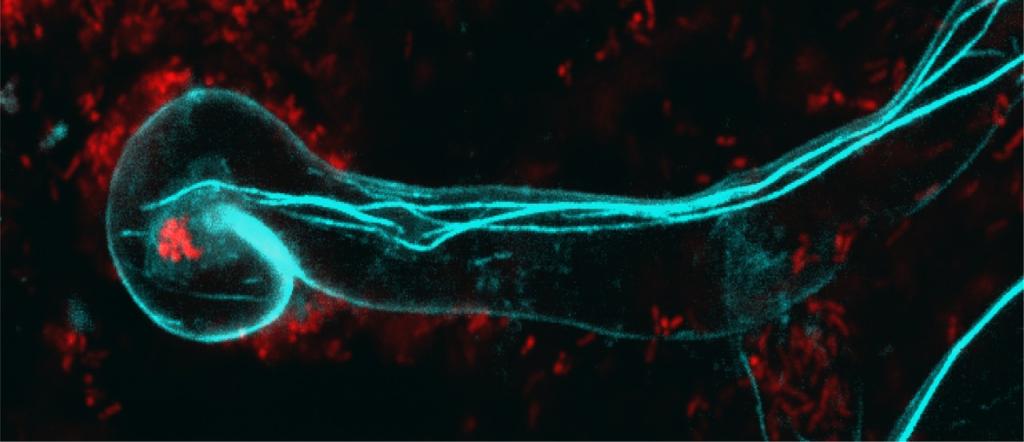
The newly published study reveals that a previously under‑characterised protein, SYFO2, plays a central role in this process. Once a root hair traps rhizobial bacteria, SYFO2 helps reorganise the plant’s actin cytoskeleton – an essential step in building the “infection thread” that transports the bacteria into the root.
“In this study, we identified the molecular basis for a key process – where the plant switches from ‘catching the bacteria’ to ‘opening the door for them,’” says Ott.
An ancient molecular pathway
SYFO2 is not unique to legumes. The research team, including evolutionary specialist Pierre‑Marc Delaux, showed that versions of the protein are present across many plant species, including those that do not form nitrogen‑fixing nodules. In several non-legume plants, SYFO2 is required for establishing mycorrhizal symbiosis, a far older and more widespread partnership between plants and fungi. This evolutionary continuity supports the hypothesis that the building blocks of nitrogen‑fixing symbiosis are not exclusive to legumes.
Activating the pathway in tomato
A particularly exciting outcome of the study is the demonstration that tomato, a crop that does not host rhizobia, can activate its own SYFO2 pathway. By introducing a regulatory factor from the legume root nodule symbiosis program, researchers successfully switched on the tomato version of SYFO2.
“This result shows that genes normally involved in mycorrhizal symbiosis can be redirected to support bacterial nitrogen‑fixing symbiosis,” Ott explains. “It’s a promising step toward advancing beneficial symbioses between crops and the soil microbiome in the hope of strengthening sustainable farming.”
A step toward more sustainable farming
Transferring the ability to host nitrogen-fixing bacteria to crops that usually cannot is a promising strategy for reducing the amount of fertilizer that farmers need. It is an important aim for ENSA (Enabling Nutrient Symbioses in Agriculture), as funded by Gates Agricultural Innovations. Innovation with the potential to reduce fertilizer use could significantly benefit environmental and human health, as well as reduce costs for global farmers, leading to more sustainable and equitable farming.
Read the full paper.
About CIBSS – Centre for Integrative Biological Signaling Studies:
The cells of complex organisms communicate via biological signals to coordinate tasks, form tissues, and adapt to environmental conditions. The Cluster of Excellence Centre for Integrative Biological Signaling Studies (CIBSS) has been studying since 2019 how to understand and communicate in this ‘language of life’. Researchers from the life, natural, and engineering sciences, as well as ethics and law, are studying how living systems integrate signals to make decisions that regulate development, function, and health – from cells to organs and even entire organisms. The cluster is developing solutions to current global challenges in the areas of health and food security. CIBSS is part of the interdisciplinary focus area ‘signals of life’ in the University of Freiburg’s research profile.
About Gates Ag One:
Gates Agricultural Innovations (Gates Ag One) is a non-profit organization that accelerates breakthrough agricultural research to meet the urgent and neglected needs of smallholder farmers in sub-Saharan Africa and South Asia. Out of the conviction that all lives have equal value, Gates Ag One serves the interests of smallholder farmers, who are most exposed to climate shocks yet lack the access that others have to the latest agricultural innovations. Gates Ag One works to level the playing field and empower smallholder farmers to transform their agricultural productivity, nutrition security and climate resilience. Learn more at gatesagone.org.
Image: Adapted from Qiao L. & Sun H. Et al. Science, 2026. Live-cell confocal microscopy image of the tip of a root hair cell showing internal structural filaments (blue) and infecting bacteria (red). When SYFO2 was removed, these structural filaments could not be seen.
Text: Emma Steer