
Abstract
Colonization of plant roots by symbionts requires substantial morphodynamic reorganization. Examples are actin-scaffolded micro-compartments called infection pockets formed during root nodule symbiosis (RNS) by legumes. Here, we demonstrate that the actin-binding formin SYFO2 is indispensable for rhizobial infection in Medicago truncatula, where it drives actin polymerization in phase-separated and symbiosis-specific nanodomains. Being evolutionarily conserved, SYFO2 also regulates symbiotically active arbuscules formed during mycorrhizal symbiosis (AMS) outside the nodulating clade, indicating that it was additionally recruited to promote rhizobial infections in legumes. Following our aim to enable nitrogen fixation in non-legumes, we additionally succeeded in activating endogenous SYFO2 by stably introducing the RNS master regulator NIN into the natural non-host tomato. This demonstrates the possibility of recruiting AM-related genes into an engineered nodulation-specific pathway.
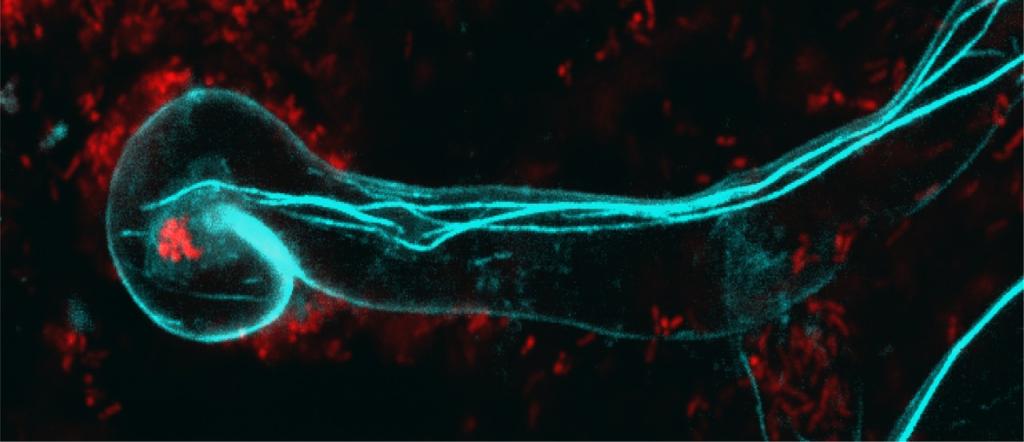
Image: Adapted from Qiao L. & Sun H. Et al. Science, 2026. Live-cell confocal microscopy image of the tip of a root hair cell showing internal structural filaments (blue) and infecting bacteria (red). When SYFO2 was removed, these structural filaments could not be seen.
Read full article