
Plants are in constant contact with fungi in the soil. Some fungi cause disease, while others form beneficial partnerships that help plants acquire nutrients and grow. To survive, plants need to tell them apart, but how they read the chemical signals fungi release has remained poorly understood. Now, ENSA researchers at Aarhus University, together with colleagues at the University of Copenhagen and CNRS-CERMAV in Grenoble, have uncovered how a plant receptor recognizes long chains of chitin, a signal linked to fungal attack. Their findings, published in Science on October 15th, 2026, reveal a highly specialized receptor system that selectively recognizes molecular fungal signals based on their size.
How plants read fungal warning signs
Chitin, a chain of repeating sugar molecules, is the main building block of fungal cell walls. When fungi grow or are broken down, fragments of chitin chains of different lengths end up in the soil, and plants detect them to monitor the microbes around them.
Long chitin fragments are commonly associated with fungal attack and trigger strong plant immune responses. But not all fungi are bad. Shorter chitin fragments, meanwhile, are associated with beneficial partnerships, including interactions with symbiotic fungi that exchange essential nutrients with their hosts. What remained unknown was how plants can tell these signals apart.
A receptor that measures molecular length
To find out, the team combined structural biology, which reveals the three-dimensional shape of proteins, with biochemistry and experiments in living plants to investigate the receptors that detect chitin at the surface of plant root cells.
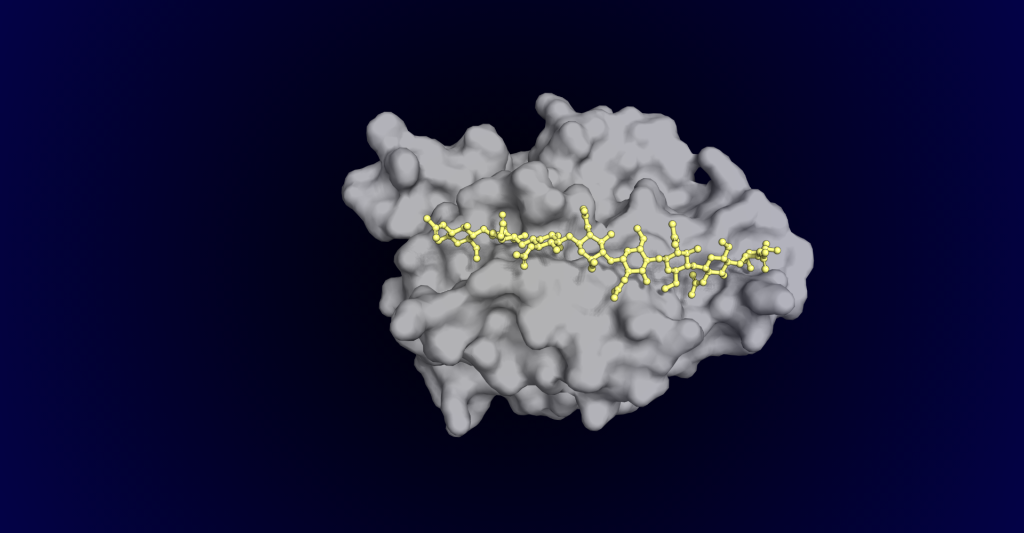
They found that a receptor called CHIP13 binds long chitin chains much more strongly than short ones. A distinctive part of the receptor, which the team calls the “bridge domain,” helps it grip the chain at several points, so that only chains long enough to span them are held tightly. This bridge domain is a hallmark of a whole class of related receptors.
“The central question was how plants tell long chitin chains from short ones. We learned that CHIP13, and specifically its bridge domain, works like a measuring tape,” says Assistant Professor Kira Gysel, who together with Professor Kasper Røjkjær Andersen, led the work. “That allows the plant to recognize signals associated specifically with a potential fungal attack and not confuse them with signals from potentially helpful microbes.”
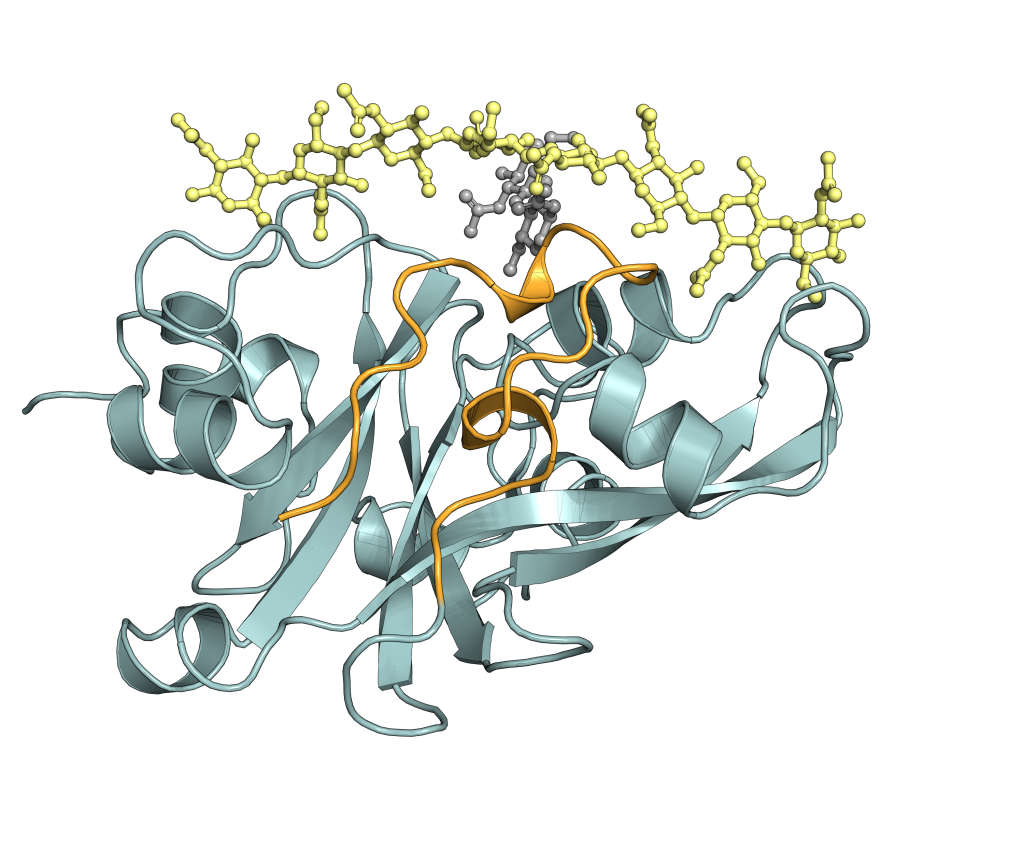
Rendering of CHIP13 structure (teal) with the bridge domain (orange), and long chitin fragments (yellow). Credit: Kira Gysel.
A division of labor
Plants also depend on a second receptor, called CERK6, to respond to chitin. Gysel, together with Simon Boje Hansen and Henriette Rübsam, the study’s first authors, investigated how the two receptors work together. The scientists found that in the presence of chitin, CHIP13 recruits CERK6, and the two form a signaling complex that activates the plant’s immune system, with a clear division of labor between the two proteins. Experiments in which either receptor was blocked confirmed that the plant needs both to mount a defense response.
“CHIP13 can recognize or ‘see’ the long chitin fragments associated with dangerous fungi in the soil. It then physically comes together with CERK6, and only CERK6 can sound the alarm for the rest of the plant,” explains Gysel. “Both proteins have very specific jobs, and both are needed for this core pillar of the plant immune system.”
“We were facing a puzzle: how can CERK6 be essential for the plant’s response to chitin, when it can barely hold on to it?” says Boje Hansen. “It turns out the two receptors split the work: one recognizes the signal, the other passes it on. Neither can do the job alone.”
“We could see this directly in plants too,” says Rübsam. “It was only when chitin was bound to CHIP13 that CHIP13 could call on CERK6. Importantly, we saw that this was also true in a second legume plant, showing that this mechanism is preserved across different species.”

Kira Gysel at Aarhus University. Credit: Emma Steer.
Balancing defense and cooperation
This study provides valuable new insights into how plants protect themselves from biological threats in the soil. It also highlights the careful balance that plants must strike every day between defense against harmful microbes and cooperation with those that are beneficial.
Beneficial fungal partners, such as arbuscular mycorrhizal (AM) fungi, which form nutrient-sharing partnerships with plant roots, are vital for plants to thrive. They help plants take up water and essential nutrients and, in doing so, improve resilience to drought, poor soils and disease. Improving these fungal partnerships with crops such as rice and maize forms a central part of ENSA’s vision.
“Understanding how plants distinguish friend from foe is essential when developing crops that make better use of symbiotic interactions,” explains Gysel. “This research highlights a critical part of the plant immune system that must remain intact, so that crops stay resilient against pathogens and yields are protected.”
This work was supported by funding from Novo Nordisk Foundation, Danish Council for Independent Research, Carlsberg Foundation, Danish National Research Foundation, and Enabling Nutrient Symbioses in Agriculture (ENSA).
Publication: Gysel, Hansen, Rübsam et al., “Structural basis for size-selective perception of chitin in plants” Science (2026). DOI: 10.1126/science.adz4600